
Business Registry Lookup vs. Structured Entity Data: What Compliance Teams Actually Need
·
Corporate Entity Data Infrastructure
·
August 2026
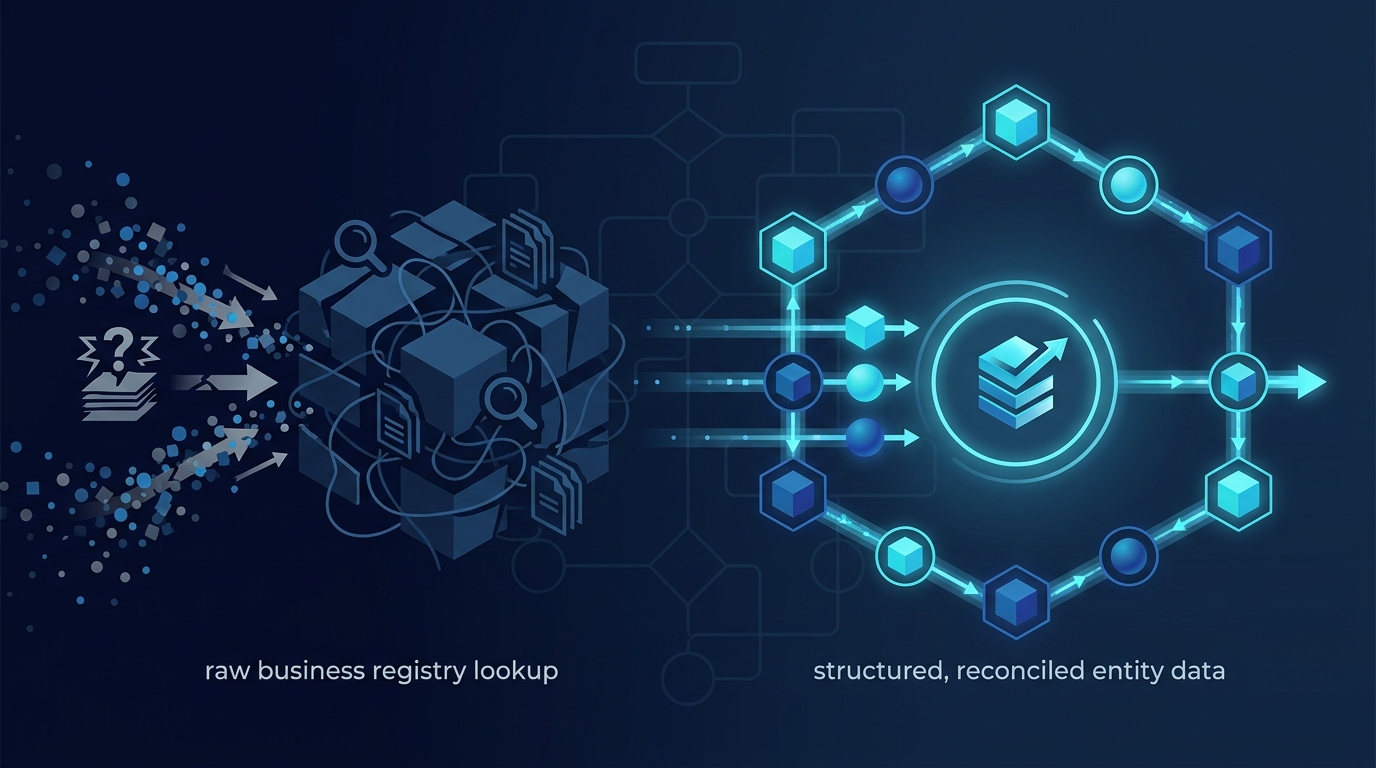
A business registry lookup and structured entity data answer two different questions. A lookup returns what one national registry recorded about one entity at one point in time, in whatever format that registry happens to use. Structured entity data works differently. It reconciles that record against other sources, standardises it into a consistent schema, and keeps it current — so it can plug directly into a compliance or risk workflow, rather than requiring manual interpretation first.
Most teams searching for a “business registry lookup” are actually looking for the second thing. This post explains the practical difference, and where a raw lookup falls short. It also covers what compliance and data teams need to check before assuming registry access alone solves their coverage problem.
What does a business registry lookup actually return?
A business registry lookup queries a single national or regional registry — for example, a company registration authority — and returns whatever that specific registry captured at the time of filing. That’s typically entity name, registration number, incorporation date, and listed directors. In short, it’s a direct, single-source answer to “what does this registry say about this entity,” nothing more.
- Beneficial ownership beyond the first declared layer
- Ownership or affiliate links to entities in other jurisdictions
- Whether the record has changed since it was last queried
- A standardised format usable across multiple registries at once
- Entity name and registration number as filed
- Incorporation date and registered status
- Listed directors or officers, where captured
- A snapshot valid as of that specific query
Why this matters for compliance teams: A single registry lookup satisfies “did we check the registry,” which is a process step, not “do we have a decision-ready entity record,” which is what a KYB or counterparty risk decision actually requires.
What does “structured entity data” add on top of a lookup?
Structured entity data starts from the same underlying registry sources. However, it adds three things a raw lookup doesn’t: reconciliation across multiple sources when one registry’s record is incomplete, a standardised schema so entities from different jurisdictions can be compared and integrated the same way, and continuous refresh so the record doesn’t go stale between queries.
- ✓ Multi-source reconciliation, not a single registry’s record taken at face value
- ✓ A consistent schema across all 50+ jurisdictions, not 50+ different registry formats
- ✓ Affiliate-link mapping between entities, not isolated single-entity records
- ✓ Confidence scoring and provenance metadata per field, so gaps are documented rather than hidden
- ✓ Delivery via REST API or bulk feed, ready for direct integration into existing systems
“A business registry lookup tells you what one registry said once. Structured entity data tells you what’s true now, reconciled across every source that has a stake in the answer.”
Where does relying on registry lookups alone break down?
The gap shows up most clearly at scale, when a data or compliance team needs to check hundreds or thousands of entities across multiple jurisdictions, not one entity in one market. A lookup-only approach means building and maintaining a separate integration per registry, handling each one’s own format, update cadence, and availability. It also means reconciling the results manually whenever an entity’s structure spans more than one jurisdiction. That reconciliation work does not scale linearly — it’s exactly the kind of build-vs-buy problem covered in our guide to registry data retrieval across Africa and MENA.
| Requirement | Registry Lookup Alone | Structured Entity Data |
|---|---|---|
| Single-jurisdiction entity check | ✓ Sufficient | ✓ Sufficient |
| Cross-jurisdiction ownership mapping | ✗ Not resolved | ✓ Core capability |
| Consistent schema across jurisdictions | ✗ Format varies by registry | ✓ Standardised |
| Continuous refresh at scale | ✗ Manual re-query required | ✓ Automated, near-real-time |
| Audit-ready provenance | ◐ Depends on registry’s own record-keeping | ✓ Documented per field |
This is a scale and integration problem, not a data-quality criticism of any individual registry. Registries do what they were built to do: record what was filed with them. The reconciliation and standardisation work sits on top of that. It’s the part that a raw lookup was never designed to provide — a pattern that plays out repeatedly across Nigeria’s registered entity landscape as much as anywhere else.

What should a compliance or data team check before relying on a registry lookup tool?
Before treating a “business registry lookup” capability as sufficient, it’s worth asking a few direct questions. Does it resolve ownership beyond the first declared layer? Does it cross-reference other jurisdictions when an entity’s structure spans borders? Does the record refresh automatically, or only on manual re-query? And is there provenance metadata attached to each field, or just a raw registry dump?
Ownership resolution: First layer only, or full chain to a natural person
Cross-jurisdiction linking: Single registry, or reconciled across all relevant sources
Refresh cadence: Manual re-query, or continuous automated update
Provenance: Raw record, or source/date/methodology per field
None of this makes a registry lookup tool useless — it’s a legitimate first step for a single, low-volume, single-jurisdiction check. But it becomes a liability when treated as a substitute for integration-ready entity data at compliance scale. This is especially true across Africa and MENA jurisdictions, where registry formats and disclosure standards vary widely, a gap covered in our methodology page. Our coverage page lists the specific jurisdictions where this reconciliation work is already built.
Frequently Asked Questions
Q: What is the difference between a business registry lookup and structured entity data?
A lookup returns a single point-in-time record from one registry as filed. Structured entity data reconciles that record with other sources, standardises it, and keeps it continuously updated for direct integration.
Q: Why isn’t a registry lookup enough for KYB purposes?
It only returns what that registry captured at filing, doesn’t resolve beneficial ownership beyond the first layer, doesn’t cross-reference other jurisdictions, and doesn’t refresh automatically.
Q: What does “integration-ready” entity data actually mean?
Data delivered in a standardised schema that a compliance or risk system can consume directly via API or bulk feed, without manual normalisation of each registry’s own format.
Next Steps
If your team is running individual registry lookups across multiple jurisdictions and reconciling the results by hand, that reconciliation work is exactly what structured entity data infrastructure removes.
Request a data sample from the Linxet data team. Specify your use case, correspondent banking, sanctions screening, portfolio company KYB, or supply chain verification, and we’ll show you what a reconciled, integration-ready record looks like against a raw registry lookup for the same entity.